Showing posts with label freight. Show all posts

Saturday, 7 September 2024

Review: Kato Koki 10000 and Kokifu 10000

Like the six-car freight pack with its basic container flat, these two models lack the finer details seen on Kato's higher-end models. On the other hand, they are definitely priced to sell, and with a bit of weathering, make good models for running behind a wide range of electric and diesel locomotives.

Background

The 10000-series container wagons were built between 1966 and 1969. They were designed to run at higher speeds (up to 100 km/h) than earlier designs. At one end is a small platform for an operator to stand on when using the hand brake.

Like other container wagons of the era, they were designed for the JNR standard 10' container. Some were modified to carry two 20' containers (the 11000 and 12000 series) instead of the 10' containers. These modified wagons could not carry 10' wagons. There were some other variants produced over the years, including one series (the 18000 series) built in 1968 for use in the cold climate of Hokkaido.

Perhaps the most unusual variant was the Kokifu wagons. With freight trains being accelerated to 100 km/h, suitable accommodation for the guard, or conductor, became an issue. Existing brake vans (cabooses) could not run at that speed, so instead a number of container wagons were built with a small conductors compartment. These wagons could now only carry four 10' wagons rather than five.

Both the Koki and Kokifu wagons were in widespread use across the network through the 1970s and 80s. The last were removed from service in 1996.

Kato 8002 Container Wagon


 What's in the box?

  • Koki 10000 container wagon
  • Non-removable containers
The wagon is nicely moulded and presented in JNR freight blue. The lettering is simple but effective. The wagon itself is solid, with only basic detail represented underneath the solebar and nothing much on the top. There is a metal weight on the top of the wagon, with all five containers represented by a single-piece that clips into the place. The metal weight seems a bit loose, so I used a drop of glue to fix it into position.

As supplied, the container moulding works, just about, but the gap between each container isn't completely convincing. Weathering makes a huge difference, giving you a reason to run some dark, watered-down paint into those gaps. This makes the gaps look more like shadows. It's also worth painting the metal weight while you have the container removed for weathering. The weigh is easily visible from the side, and if you paint it black, it won't be nearly as intrusive.

Kato 8003 Container Wagon with guard's compartment
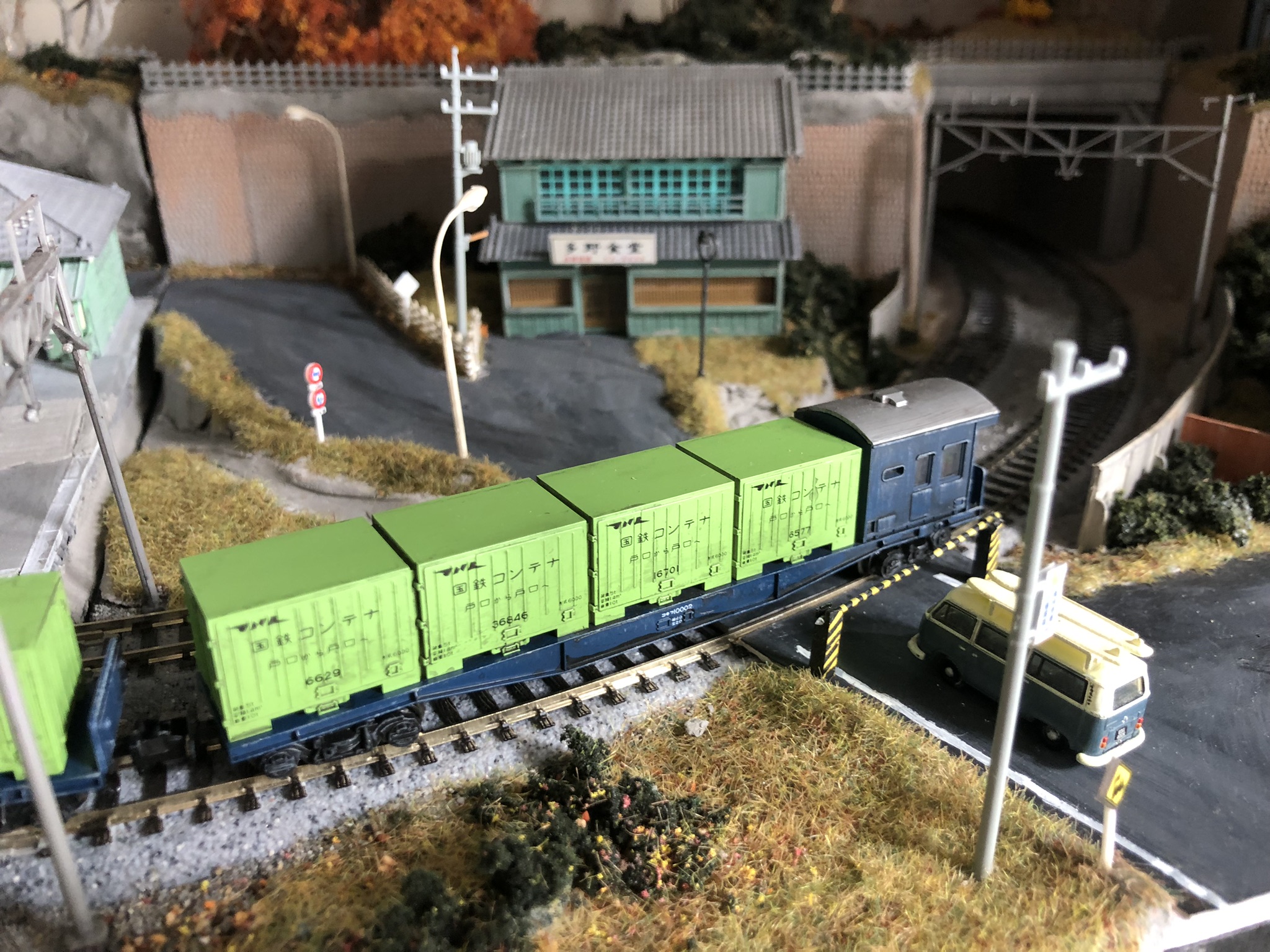
What's in the box?

  • Kokifu 10000 container wagon
  • Non-removable containers

Basic specification much like the Koki 10000 wagon, but with the distinctive caboose, or conductor's compartment, at one end. Again, judicious weathering will really help make the single-piece container moulding more realistic.

On the plus side, this is a quirky prototype that adds interest to any container train. But on the other hand, the low-end specification mean the model isn't as good as it might be. There are no working taillights at the back of caboose, and neither is it possible to add the Kato lighting kit to illuminate the inside of the guards compartment.

Summary 

The Koki container wagon has an RRP of 770 Yen (about £4.25 at the time of writing) while the Kokifu one with the caboose is slightly more expensive at 825 Yen (about £4.50). In either case, that's pretty impressive value as the models run well, look nice, and represent a useful, long-lived prototype.

Of course, they're compromised in significant ways. The container loads aren't removable, so you can't swap the supplied containers with different ones to add variety to your trains. Equally, as you can't remove the containers, you can't run an 'empty' train, and even if you could, the wagon frame isn't open and lacks the details such as pipes you'd expect to see on a modern-spec model.

Thursday, 29 August 2024

Review: Kato Koki Container Wagons

Whereas the six-car freight pack contains Kato's basic container flat, the model shown here is built to a much higher specification. As well as much finer detailing and an proper open frame, the wagon is supplied with individual containers that can be removed or swapped for other ones in different colours. This makes the wagon much more versatile and interesting to own, particularly if you want to model a train with a mix of containers.

Background

Japan is unusual in that a lot of containerised freight is moved around the country by sea rather than by rail. Nonetheless, containerised freight was first carried on the railways as early as the 1930s. The first containers were relatively small and carried on two-axle wagons, but in 1962 the first generation of proper container trains entered service. These used bogie wagons capable of carrying five 5-ton containers at speeds of up to 85 km/h.

The Koki 5500 series was the first generation of bogie container wagon. These were built between 1962 and 1975. Over three thousand of them were built, so needless to say these were common wagons that could be seen across the network. They were also quite long lived, the last ones withdrawn during the early 2000s. On the current railway they have been replaced by more advanced types such as the Koki 100 series.

One quirk of the Japanese railway system is that the containers used for internal traffic are not the standard ISO types seen elsewhere in the world but their own set of sizes. The most common container is the Type 1 (12') rail container, five of which fit on a 60' Koki flat. Type 2 (20') and Type 3 (30') containers are also common, with either three or two of these fitting on the container wagon.

Kato 8059-1 Container Wagon (two-pack)

What's in the box?

  • Two Koki 5500 bogie container flats
  • Ten removable containers


These are typical Kato wagons with a mix of moulded and separately fitted details. The handrails and brake wheel are a single piece that clips onto the wagon body, while the brake pipes and rods (visible when the wagons are removed) form another piece that clips into place. The bogies are held on with screws, while the Rapido couplings are the traditional sort with a spring behind them that keeps them centred. If you want, you can replace these with either buckeye couplings (Kato #11-702) or magnetic couplings (Kato #11-711) as you prefer. 


The clips that secure the containers are visible along the top of the wagon. While somewhat comprised in shape to act as springy clips, similar structures are present on the real wagons to secure the containers. Overall, the detail does the job, even if the colours aren't consistent between the different plastic components. Etched brass might have allowed the handrails and handbrake wheel to be more delicate, but as it is they look fine from normal viewing distances.

Ventilated containers (6000-type) are included, but the 5000-type containers will fit as well. These ventilated containers were primarily used to transport fruits and vegetables. The containers are painted in the standard JNR green that was used all the way through to privatisation, while the wagon itself is painted in the standard reddish-brown of JNR freight vehicles. So, the wagons would look most authentic running in trains between the 1960s and 1980s, though doubtless some wagons (and containers) stayed in their JNR colours well after privatisation.

Summary 

At the time of writing, the RRP for this twin-pack is 3,520 Yen (about £18-19). That puts them towards the more expensive end of the scale compared with other Kato freight cars. Compared to the basic Koki container flat like the one that came in the six-car set, the key differences are the open chassis with visible pipework, the separately fitted handrail and handbrake wheel, and of course the removable containers.

Review: Tomix Wamu Covered Wagons

Like the two-axle Komu container flats, these are examples of wagons that Tomix has produced for a very long time. While definitely towards the more basic end of the range, they are very inexpensive. Does that make them worth buying though?

Background

The Wamu 80000 series are two-axle general purpose goods wagons that were built in large numbers from 1960 until 1981. They were built by a number of different companies including Kawasaki, Mitsubishi, and Nippon Sharyo. Successive batches of wagons were improved with things like better shock absorbers and roller bearing axles that allowed them to run at higher speeds, up to 75 km/h. The 28000 type was given a slightly longer wheelbase to improve stability, and the steel side doors replaced with aluminium ones.

Up to 15 tons of cargo could be carried, usually on pallets that could be quickly loaded and unloaded by forklift trucks through the sliding side doors. As well as palleted goods, these wagons were also used at times to transport things like motorcycles and even plate glass.

The last ones being withdrawn from commercial use in 2012. Quite a few were modified for specific sorts of traffic, such as beer and even fish (some of the 58000 type). A more extreme modification was made for transporting wood chips, with the side doors sealed up and the roof opened and given a tarpaulin cover (the 48000 type).

A few remain in use on private railways. Some have even been repurposed as sheds or even waiting rooms for quiet stations!

Tomix 2714 (80000-type) and 2715 (38000-type)

What's in the box?

  • Two-axle covered wagon with Rapido couplings


Although physically similar, the two wagons represent different types. The brown wagon is the 28000 type wagon, improved over the original for faster running but otherwise the same sort of general purpose wagon. The brown livery shown here, known as Tobiko #2, was the the standard for freight cars from 1960 onwards. The blue wagon is from the 38000 series, which were wagons upgraded with roller bearings from 1990 to 1993. Once they were modernised, the wagons were repainted into a shade of blue known as cargo blue, which is what you see here.

On the plus side, these wagons are nicely moulded and seem to resemble the real things rather well. While there aren't any separately fitted parts, such as handrails, all the basic details are there. The chassis, in particular, has the right look, with things like springs and brake rods where they should be. It doesn't seem to be a generic chassis (as you might expect for such a cheap wagon) but one that broadly approximates to the real thing.

But on the other hand, the paint work is very simple, and there are details on the chassis that could be picked out in white to better match the prototype. The wheels are not chemically blackened. The couplings are not easily switched out for other types, but the traditional sort with a springy bit of metal behind the coupler, all contained in a tiny little box. Open that box and you're likely to spend some time looking for that springy bit of metal... guess how I know!

Summary

As with the container flats, for a wagon costing a little over 600 Yen (about £3.50) it feels churlish to call out too many shortcomings here. These are attractive, useful little wagons that could be seen almost anywhere in Japan across a very long period of time. The fact they were used for palleted freight makes them idea for private sidings serving whatever industry you want to feature on your layout.

There are some nice pictures online, such as this one at Wikimedia, that would make a good starting point for anyone wanting to tweak their Wamu wagon into something more authentic. All it would really take is some white paint to pick out the details around the chassis, and then a bit of weathering to make the wagon look more 'used'. 

Review: Tomix KOMU 1 Container Wagons

These quirky wagons have apparently been part of the Tomix range for a very long time. Earlier versions had the two containers modelled as a single piece, but later versions (from 1996) featured separate containers. The versions shown here, first produced in 2008, were further enhanced with a more realistic chassis and better detailing. Although quite old, these wagons are still widely sold and don't seem to have been updated at all.

Background

Komu wagons were rebuilds of the Tomu 50000 open wagon. They were built in 1968 and used exclusively on Hokkaido (in fact they carried a sign stating they should not used outside that prefecture). They were designed to carry two 5-ton (11') containers at speeds of up to 65 km/h. Forty of them were built, numbered Komu 1 to Komu 40.

Because they were not compatible with the slightly larger and more common 12' containers, these wagons were soon rendered obsolete. The last one was withdrawn in 1977.

Tomix 2718 (JNR container wagon) and 2719 (JNR refrigerator container wagon)

What's in the box?

  • Komu 1 two-axle container flat
  • Two removable containers

The wagon with the green containers is the basic sort, while the white containers on the wagon below are refrigerator containers used to carry perishable goods such as meat or vegetables. The printing on the containers is excellent -- very sharp and easy to read. There is also some lettering on the sides of the wagon.

So far as detailing goes, the brakes and springs around the wheels are replicated nicely, and some pipes and struts can be seen underneath as well. There's not much on the top of the wagon though, and incorrectly, the top is one solid piece (it should really be open in the centre). There are three pairs of clips moulded onto the top as well, onto which the containers can be attached. Depending on how you use these clips, you can model the wagon with two containers as in the photo above, or a single container to the left or right, or a single container placed centrally. The clips aren't realistic, but aren't too noticeable either.

Otherwise the wagons are typical of Tomix rolling stock from this era. The wagons are fitted with Arnold Rapido couplings and do not have chemically blackened wheels. On the plus side, the wagons are free rolling and handle tight curves perfectly well -- my two will travel around 15 cm radius curves without complaint!

Summary 

For the price (600-700 Yen, around £3.50) these wagons represent good value even if their usefulness is somewhat limited. The detailing compromises are fair, given the price, so it's hard to complain about them.


Installing the Kato lighting kit into the Yo 5000 brake van

The freight car pack described in another post includes a lovely little brake van (caboose) with working tail lights. You can also add one of the Kato lighting fixtures (Kato #11-213) to illuminate the inside of the brake van, but the instructions provided are in Japanese and not particular clear. In particular, two or three important steps aren't illustrated in the diagrams, so if you're working from those alone, you might struggle a bit.

Missing step 1


Taking apart the brake van is easy to do, with the various parts unclipping one at a time. Once you do that, the brass contact strips slide through obvious slots and as the instructions show, you need to use some wire clippers to snip them back to the right length. But what happens next isn't so clear!

As far as I can tell, the white plastic housing the contains the LED (and the orange colour filter) clips in at the opposite end to the grey plastic column, as seen in the photo above. It may take some fettling to get the brass contact strips pressing firmly against the electric pick-up strips on the white plastic piece. In the end, I used a couple of drops of superglue to ensure the white plastic piece stayed in place -- leaving the brake van on a piece of Unitrack with the current on so that I can see that everything is lighting up properly. 


Missing step 2 


The next step is to install the light diffusion bar into the roof. Although the diagram indicates the bar should run across the whole length of the roof, if you do that, it won't fit back onto the body. At best, you get half the roof, as shown above. This allows space for the top of the LED circuit board to fit flush against the roof while shining down the light diffusion bar.


 Missing step 3  


Finally, the grey plastic column needs to be snipped back a few mm to create some space for the light diffusion once the roof and body are reunited. If you don't do this, the grey plastic column will press against the diffusion bar and stop the roof fitting correctly.


The end result!


You can now reassemble the brake van and with any luck the roof and sides will clip back onto the body without any problems. The result is a brake van with internal lighting as well as working taillights.

Wednesday, 28 August 2024

Review: Kato 10-033 freight car set

Kato currently produce several starter packs of coaches or wagons that provide an inexpensive way to build up your rolling stock collection. The coaches or wagons are carefully selected to be appropriate to quite a broad time frame. The freight car pack, 10-033, contains six different models including a brake van (caboose) with working taillights. It was first released in 2019, then re-released in 2023. As far as I can tell, the two releases are identical, right down to the running numbers on the wagons.

Background

Although Japan has an extensive railway network, most of the trains are passenger trains. Less than 1% of the freight movements within Japan go by rail. The volume of freight traffic in absolute terms is substantial, over 26 million tons in 2023, but to put this in context, across an equivalent period in the UK, almost 70 million tons of freight was carried.

Much of the freight transported on Japanese railways today is containerised, but in the past a wide variety of freight cars could be seen. As was the case elsewhere in the world, pick-up goods trains declined through the latter half of the twentieth century, being replaced with trains consisting of a single commodity in wagons capable of running at high speed. Usually, these trains consist of raw materials such as oil or grain, rather than finished goods. One problem is that freight trains have to run on the slower Cape-gauge lines rather than the high speed standard-gauge (or Shinkansen) lines which hampers reliability and efficiency. Japanese cities also tend to be built on the coast which makes shipping a more economical way to send bulk commodities from point to point.

Nonetheless, Japanese freight services are interesting and attractive to modellers. While the most authentic approach might be to focus on container trains, the classic mixed goods train is appealing. That's where this freight car pack comes in!

Kato Freight Car Park (10-033)

What's in the box?
  • Waki 5000 bogie box car
  • Tora 45000 two-axle open wagon with removeable tarpaulin
  • Hoki 2200 bogie grain hopper
  • Koki 5500 bogie container flat with containers
  • Re 12000 two-axle refrigerated car
  • Yo 5000 two-axle brake van
  • Optional dummy coupler for the brake van

Waki 5000 bogie box cars were in service between 1965 and 2002 and featured sliding doors on the sides that allowed palleted loads to be quickly loaded and unloaded. All sorts of goods could be found on these wagons and they were very widely used across the network. They could carry up to 30 tons of cargo and were designed to operate at quite high speeds, up to 85 km/h. The model runs smoothly and looks quite nice, though the colour scheme isn't very interesting.

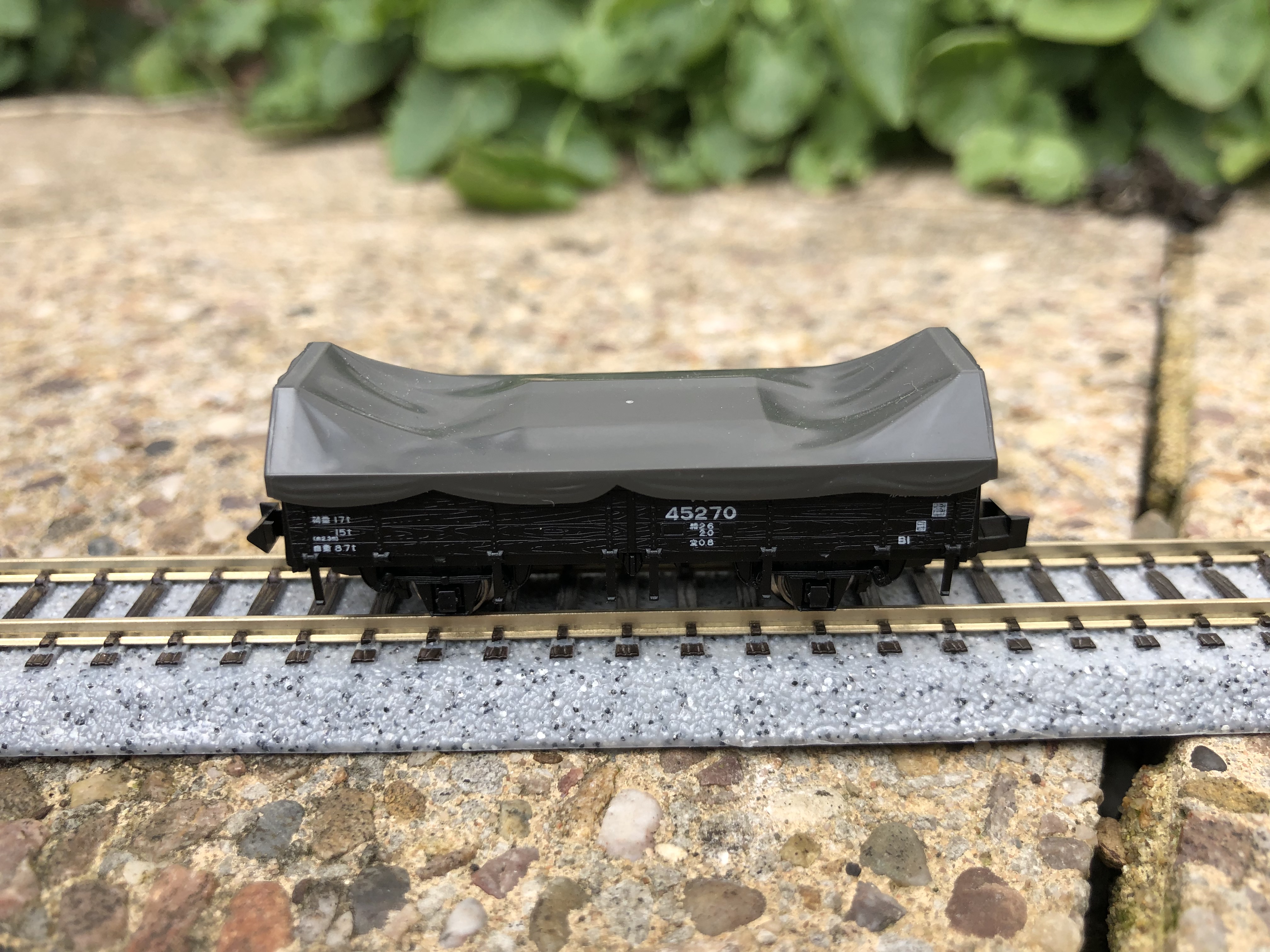
The Tora 45000 is a two-axle open wagon of a type built in large numbers between 1962 and 1963. Most have been scrapped, but a few remain in use, and some have even been converted into open passenger cars for heritage lines! Although the model looks rather plain in standard freight black livery, it features simulated wooden grain on the planks, neatly applied lettering, and a removeable tarpaulin that means the model can be operated open or covered as you prefer.

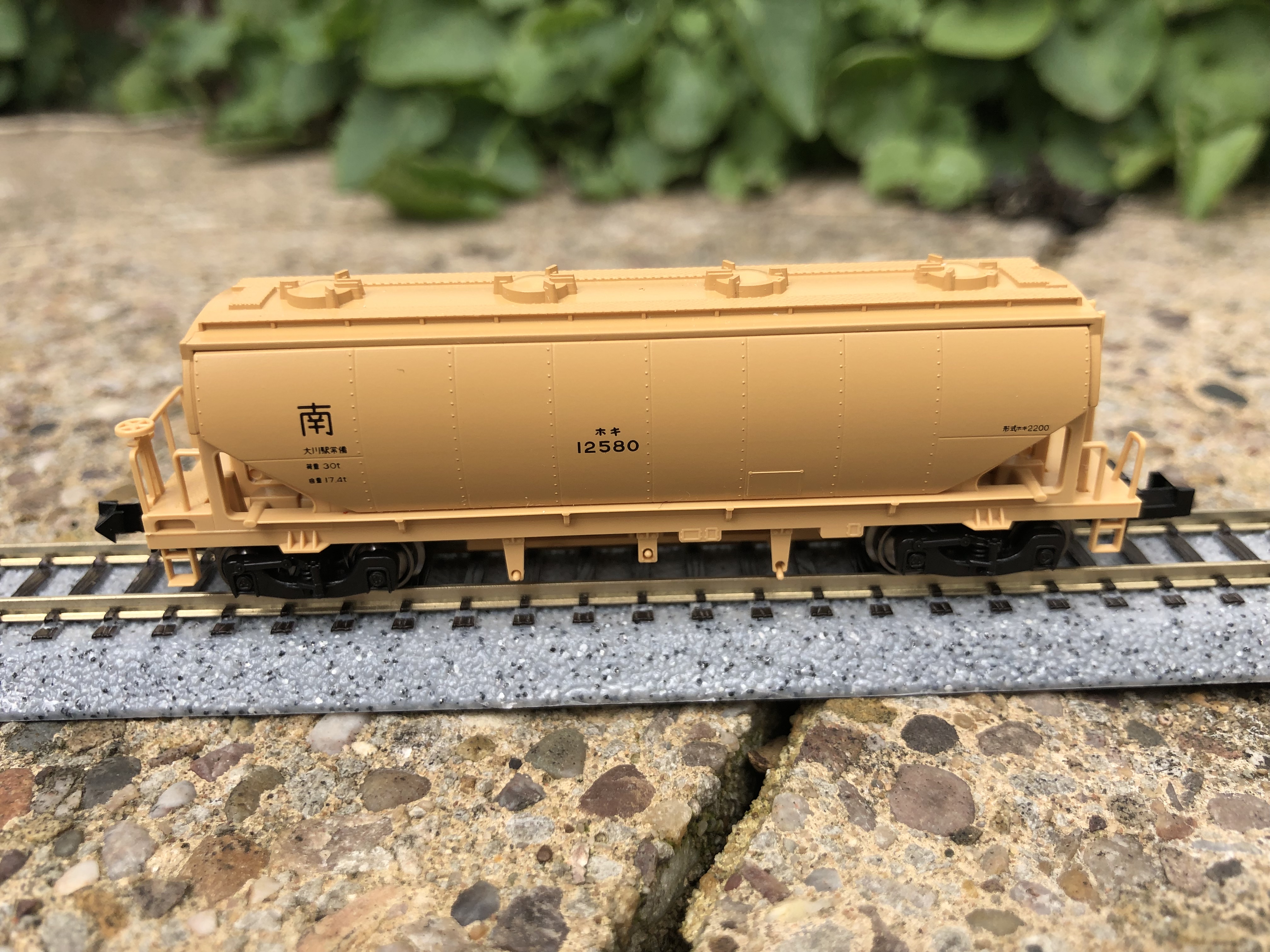
Compared with the previous two models, the Hoki 2200 bogie grain (wheat) hopper is very eye-catching. This design of hopper was in service between 1966 and 2000, so were quite long lived. The wagon resembles grain hoppers seen in the US. Besides transporting grain for food production, some were also used to supply breweries. The wagon sports some nice moulded details and runs very smoothly, even if some of the details, like the handwheels for applying the brakes, are relatively chunky.


Of all the wagons in the pack, the Koki 5500 bogie container flat is probably the star! It's big, runs beautifully, and is an almost essential wagon for any Japanese layout. Container trains are a major part of Japan's freight traffic and the green containers here were used for many years. The first Koki 5500 wagons were introduced in 1962 and they could be seen running across most of the country for the next four decades. Note that the five containers (representing the ChiKi 5000 type) are, in fact, a single moulded piece. As they come, this doesn't look particularly convincing, so I have weathered mine with some diluted black acrylic while also painting the metal weight black so that it isn't visible underneath the containers. With a bit of extra weathering to give the chassis some character, the result is a serviceable wagon that does the job even if not quite so smart or detailed as the higher-spec container flats from Kato and Tomix.


The Re 12000 is a 12-ton, two-axle, refrigerated car designed to carry foodstuffs. Ice was stored in the roof to keep the wagon cold. These wagons could run at up to 75 km/h and were in service between 1954 and 1986.


Finally, the pack includes a Yo 5000 two-axle brake van in standard black livery. This model has some nice detailing around the verandahs and properly glazed windows. The taillights also work, glowing red when the train is moving along. Even better, if the roof is unclipped the coach lighting kit (11-213) can be installed to provide interior lighting.

Conclusion

For an RRP of 7,150 Yen (about £37) and widely sold in Japan for well under that, this wagon pack is an absolute bargain when compared to some of rolling stock sold in other countries. The actual saving compared to buying the wagons separately is negligble though (by my reckoning, the RRP for these wagons is 935 + 990 + 990 + 550 + 935 + 1,980 = 6380 Yen, which is about what the set goes for at the usual online retailers).

But while the pack is definitely good value, there are compromises here. The two-axle wagons, in particular, are basic models with no separately fitted details and dull colour schemes. The grain hopper is a lovely model, but the detailing around the platforms at each end, such as the hand rails, are quite coarse. Similarly, while the container flat does the job, the single-piece container load needs some weathering to look convincing. Kato (and Tomix) do produce higher higher-spec Koki container flats with much more detailing as well as properly removeable containers, but these cost a lot more -- Kato #8059 costs 3,520 Yen (about £18).

Although Kato have selected prototypes that were in use across a long period of time, and might be seen behind steam, diesel, or electric locomotives of various types, whether they'd actually all be running in the same train is open to debate. Still, you could realistically stick the smaller wagons behind a tank engine like a C11 or C12 without embarassement, while the hopper and container flat look really nice behind a diesel or electric locomotive in a more modern setting.

The wagons can also be upgraded with either manual buckeye coupings (Kato #11-702) or magnetic couplings (Kato #11-711) for more realism. The magnetic couplings, together with the decoupling Unitrack piece (Kato #20-032) would allow for hands-free coupling and decoupling, would make this a fun pack for shunting puzzle layouts.

On balance, this is probably a pack for the newcomer to Japanese model railroading looking to just run some trains without worrying too much about realism or detailing. None of the wagons is useless, and with additional wagons added as the modeller gets a better idea of what they like to run, there are wagons here that will always remain useful.

Kato Mini Diorama

Built this for the Warners model railway exhibition at the Birmingham NEC last year. Can you guess what it is? The model, by the way, is the...