Showing posts with label passenger. Show all posts

Sunday, 20 July 2025

Solving the mystery of the derailing Yakumo

As mentioned in my review of Kato's 273-series 'Yakumo', one frustration was the tendency of the 8-car set (Kato 10-2000) to derail.

Snowplough?

This is definitely one possible source of problems. If you look at the photo below, it's obvious that the snowplough is very close to the track. Unitrack laid flat on a table won't be a problem, but on a scenic layout you will need to check for anything the snowploughs could catch on.

Removing the snowplough is easy enough, but do be careful to wiggle it free: it's a clip-on detailing part, and if you pull too hard, the clips will snap off. Ask me how I know!

Alternatively, you could file back the snowplough to reduce its depth. As you can see in the photo below, there's certainly enough plastic to make this possible without weakening the part too much. Only the leading cars have snowploughs. I found filing back less than 0.5 mm made enough of a difference to be worthwhile. Okay, the snowploughs are now a bit smaller than they should be, but they're still there, which is better than removing them completely!

Couplings?

The couplings do a lot of work in this set, and as the picture below shows, the set is able to turn around quite tight corners while also tilting (a feature of the real trains).

The couplings within the set, i.e., not the ones on the cab ends, work without problems. The ones at the cab ends are a bit different and need to be pulled forward before they will work. There's a black sliding cover underneath that needs to be pulled back to release the grey plastic coupler. Once that's done, the coupler will work reliably.

If you don't do that, the train will derail as soon as it hits a curve. That's because the coupler won't be able to move from side-to-side properly.

Bogies?

While doing the things listed above helped, they didn't 'fix' the train completely. It wasn't until I looked at the bogies until that happened. I noticed that the bogies aren't symmetrical front and back. On a whim, I wondered if turning them around would make any difference. Amazingly, it did! Suddenly, the train was mostly running around an oval of Unitrack without derailing.

So, I looked at the bogies to see if there was a reason why this should be. If you look at the photo below, you can see the a clip in the centre that holds onto the chassis. Towards the bottom of each bogie, a plastic rectangle that ends in a clip. This is the bit would hold the snowplough if the bogie was on a driving car.

You can also see on the bogie on the right a small light grey circle sitting inside a recess. This appears to be from the moulding process and doesn't do anything. I wondered if it was catching on something as the bogie moved. It certainly felt a bit rough. So, I took a needle file and got rid of it, as you can see on the bogie on the left. While I was at it, I used a round needle file to make sure the circular clip in the centre was nice and clean, and then a flat needle file to smooth off the top of the plastic rectangle.

I also checked that the underside of the chassis was right, too. In the next photo you can see the brass strips that press onto the electrical contacts on the top each bogie. These carry the current from the track into the passenger car. This will be used for the headlights (on the driving cars) and the internal lighting (if fitted). Curiously, the brass strips are bent on the passenger cars (left) but flat on the driving cars (right).

Anyway, once the bogies was tidied up as described above, the result was transformative! 

'Yakumo' fixed?

As I write this, my Kato 273-series 'Yakumo' has been running around my scenic layout for about an hour at half-speed without any sign of trouble. It hasn't derailed once. Compared with before, this counts as a fix, and brings this Kato train into line with all my other Kato trains.


    Sunday, 18 May 2025

    Review: Kato 10-1999 and Kato 10-2000 Yakumo Limited Express

    This isn't just a new release from Kato, but a new train on Japanese Railways. Released in March, 2025, Kato have produced two versions, a 4-car starter pack (20,350 Yen) and an 8-car special edition (38,500 Yen) in a slip case.

    Background

    The 273-series 'Yakumo' is one of JRWest's newest trains. Operating between Okayama (on the San'in Main Line) and Izumo (on the Hakubi Line) the route passes through numerous towns as well as famously beautiful scenery. However, earlier generations of rolling stock had a reputation for being a bit shaky and uncomfortable. So, the new 'Yakumo' trains were designed, therefore, to be much more smooth as well as fast. The big, comfy seats can be rotated so that they can either be airplane-style or face-to-face for groups traveling together, and the bathrooms are spacious enough for people in wheelchairs to use easily.

    Mechanically, these are tilting trains (something the Kato model replicates) with a maximum speed of 120 km/h (about 75 mph) that operate on 1500V DC. Their livery is unique, a sort of coppery-brown with cream around the windows and a distinctive white cloud design on the sides and cab ends that represents the 'Yakumo' branding.

    Kato Class 273-series 'Yakumo' (10-1999)

    What's in the box?

    • One powered car and three unpowered cars
    • Accessory pack including replacement one pair of folding doors and a single gangway piece
    • Sticker sheet including destination signs
    • Class 273 information booklet
    • Instruction leaflet


    Described as the Starter Pack version of the train, at 
    20,350 Yen this is also the cheaper of the two 'Yakumo' trains produced by Kato. It is presented in the cardboard box and expanded polystyrene tray as their other budget offerings, such as the freight car starter pack and the old-style passenger train pack. So, it's easy to store this train pack alongside those on the same shelf.

    The cars need to be pushed together on the rail for the couplers to engage with a 'click'. Once that's done off the train goes! Performance is excellent thanks to its slot-less motor, pretty much what you'd expect from any modern Kato train. Cab-end lights come on with minimal current and stay uniformly bright as the train accelerates smoothly.

    Externally, the models match our expectations from Kato. The paintwork and printing is excellent, though there has been some discussion as to how effectively the paint on the model matches the glossy, even metallic, finish seen on the real trains. I'm on the fence on this one. When we're looking at model trains on a layout, every 30 cm we stand away from the model is 45 m in the real world, and colours look different as distance increases.

    Otherwise, these are nice trains. As is often the case with Kato trains, there are a couple of upgrades available using optional parts available from the usual suppliers. For a start, there's the addition of interior lighting, for which Kato recommend the 'warm white' lighting kits. You'll need at least four of the single-piece pack (#11-213) for a four-car set, although the 6-piece pack (#11-214) is better value if you can use the two spare lighting kits on other trains.

    The other upgrade uses #28-220 to replace the lighting boards for the headlights at the cab ends. On the real trains, when two units are coupled together, the headlights of the two cabs that face each other stay illuminated, regardless of speed or direction of travel. This is a safety feature apparently, lighting up the area around the platform where the streamlined cab ends create a gap where somebody could fall into. I've not tried out this upgrade, but there's a nice overview on another blog, here.

    According to the instruction leaflet, the set can be made DCC-compatible using #29-351 for the motor, #29-352 for the head/tail lights, and #29-353 for the interior lighting (if installed). These are replacement circuit boards for the analogue boards already fitted.

    Kato Class 273-series 'Yakumo' (10-2000)

    What's in the box?

    • One powered car and seven unpowered cars
    • Accessory pack including replacement two pairs of folding doors and a two gangway piece
    • Sticker sheet including destination signs
    • Some sort of screwdriver-like tool, perhaps for switching on/off the headlights
    • Class 273 information booklet
    • Instruction leaflet

    Although basically similar to the 4-car Starter Pack, I found the 8-car train a bit more problematic. Livery and performance are the same, but the lack of English-language instructions caused some initial frustration!

    For a start, two of the cab units have non-working couplings. These look like small, grey, L-shaped pieces of plastic. They (and the grey pockets they clip into) can be removed and replaced with standard couplings and pockets, but since the 'Yakumo' only operates as 4-, 8-, and 12-car trains, there's no real point to doing so: just make sure these driving cars are at the ends of your train.

    The other two cab units are the ones with working couplings seating in black pockets. However, as supplied the coupling is recessed slightly so its doesn't flop about when used as 'dummy' couplings at the end of a 4-car train. So, you need to slide the pocket forwards to release the coupling, which now becomes longer and much more flexible. If you don't do this, the trains will couple up just fine, but as soon as the train hits a curve it'll derail because the couplings don't move.

    Apparently, this approach is not uncommon on Kato trains, but I'd not come across it before. Well, 'today I learned', as they say!

    Once this hurdle had been overcome, I still found the train derailing, though this time only at one particular spot. It turned out that one of the snowploughs kept catching on a piece of rail. In fairness, this was at a joint between two boards, so the railhead might well have been fractionally out of line. But none of the snowploughs on the other 'Yakumo' units caught themselves here. Odd.

    There may be an issue with the moulding of these pieces, as similar observations have been commented on, here and here. As it happens, the fix was easy. The bogie unclips and that allows the snowplough to be detached easily. A few strokes with a file reduced the thickness of the snowplough, and when it was put back into place and the train reassembled, it ran flawlessly.

    The photo below shows the underside of one of these cars: the coupler can be seen as well as the wedge-shaped snowplough and the headlight switch.

    Unlike the 4-car pack, the 8-car pack only includes two driving cars with through doors (or, at least, the open doors and gangways needed to replicate them). The other two driving cars cannot be adapted in this way, and furthermore, are fitted with non-functional (but more prototypical) couplings. This means that these two driving cars must always be at the ends of the train, whether it's being operated as a 4-, 8-, or 12-car unit. So, if you choose to combined this train pack with #10-1999 to create a 12-car unit, the four cars from #10-1999 need to be sandwiched in between the two 4-car units in #10-2000.


    Fitting the gangways isn't too difficult but the replacement doors are very thin and easily snapped -- please don't ask me how I know! You start by removing the body shell from the chassis, then gently sliding out the cab detailing part. The piece of plastic that forms the sealed doors unclips and falls out the front, revealing a space into which the corridor connection clips. The whole process takes 5-10 minutes, and as you can see from the picture above, looks quite good despite the inevitable gap between the two cars.

     Conclusion

    Despite one or two mishaps along the way, once the couplers were sorted and the snowplough fixed, the train ran beautifully.

    Detailing is mostly moulded, as is typical with Kato, but there are some separately fitted details worth noting beyond the doors and gangways already mentioned, such as the pantographs. There are no fewer than four of these on each 4-car unit! All can be raised and lowered as needed. As far as I can tell, only two are normally used on the real things at any one time.

    There's a Kato Sound Card for the 'Yakumo' train that includes a number of authentic sounds to add to your driving experience. The card has both controller priority mode and sound synchronisation modes. In controller priority mode, you drive the train as normal, and the Sound Box reacts to things like curves and gradients automatically, for example, by having the motors 'whine' more as they work harder. In sound synchronisation mode the train speeds up and slows down more realistically, and the Sound Box plays the appropriate sounds (such as brakes and motors) as it does so. There are three horns available, one of which has a nifty Doppler effect which works nicely when the train is zipping past you.


    Sunday, 27 April 2025

    Review: Kato 10-1764 KuMoHa 52 Iida Line train

    Kato currently produce two different versions of the KuMoHa 52 series: the first batch (#10-1764) and the second batch (#10-1765). While similar at first glance, the most obvious differences include the windows (smaller on the first batch) and the air vents on the roof (circular on the first batch and a mix of circular and rectangular ones on the second batch). This review looks at #10-1764, the first batch trains.

    Background

    Built in 1936 and 1937, the KuMoHa 52 series was initially used for fast passenger services around bit cities, particularly Osaka. The first two batches had streamlined front ends that very much reflected the sensibilities of the time. However, with a maximum speed of 95 km/h the streamlining didn't really offer any practical benefits, and a third batch of trains was built with conventional front ends. Inside the trains sported wooden panelling, electric lighting, limited overhead luggage storage, and nicely upholstered seats.

    Kato are modelling the trains as they were seen on the Iida Line between 1957 and 1983. This 1500V DC line runs for about 121 miles, much of it single track, and is famous for its attractive scenery and seemingly deserted stations.

    Kato KuMoHa 52 (10-1764)

    What's in the box?

    • Powered driving car and three non-powered cars
    • Jumper cables on plastic sprues
    • Iida Line booklet

    The first thing that grabs your attention is the livery. The combination of blue and cream works really well. It is neatly applied with sharp edges where the two colours meet. Apart from the pantographs, there are no separately fitted details; handrails, etc., are all moulded. Each of the driving cars features one large headlight on the roof and two small red tail lights below the front windows. Removing the body reveals a switch that allows you to switch off the lights if you want to (useful for driving cars in the middle of 8- or 12-car formations).

    All the cars are equipped with couplers based on the 'old national' type of coupling used on the Japanese multiple units. These are slightly fiddly to use: they click together just fine, but pulling them apart can require an alarming amount of force.

     is as expected for a modern Kato train. The slotless motor and brass flywheel ensure a smooth, steady response to the controller. Maximum speed is considerably above that seen on the real things, and a slightly lower gearing would have been better. But with that said, the trains move smoothly at low voltages, so this isn't a major problem.

    As is usual with Kato coaches and multiple units, you can add internal lighting if you want to but it doesn't come supplied as standard. All the bogies have electrical pick-up, the wheels having pin-point axles that press onto copper contacts.

    Like the coaches in the 4-car pack from Kato, this train comes with non-prototypical disc wheels rather than spoked wheels. If you want to replace them with authentic spoked wheels, the ones with 13.2 mm axles are the ones required for these older units. As far as I can tell, you can only replace the un-driven wheels on the trailing cars, not the driven wheels on the power car.

    Also included in the box is a leaflet about the Iida Line and the Unitrack assortment produced to replicate it. If you have 210 x 110 cm available, it looks a lot of fun!

    The train is presented in a foam-lined slip case for easy storage. A bit larger than a paperback book, this is easily stored on a bookshelf and should keep your train safe when out of use.

    Conclusion

    This a lovely 'old timer' sort of train that will surely grace many layouts. On the plus side, the paintwork is attractive and the moulded detail nice and sharp. Quibbles about maximum speed aside, the train moves quietly and smoothly across the power range thanks to a well-built mechanism.

    The two main negatives are more about what's not included but available as upgrades: the spoked wheels and the internal lighting. I'm on the fence about the couplings. They seem to work well but don't look especially durable.

    Definitely worth mentioning is the existence of a Sound Card for this type of train. This adds some excitement to driving the train, but doesn't, perhaps, offset the lack of a DCC slot or easy DCC upgrade.

    RRP is 19,030 Yen, around £100, which feels like good value for a four-car train.

    Sunday, 6 October 2024

    Review: Kato 10-1345 KuMoHa 11 200 Nambu Branch Line 2-Car Set

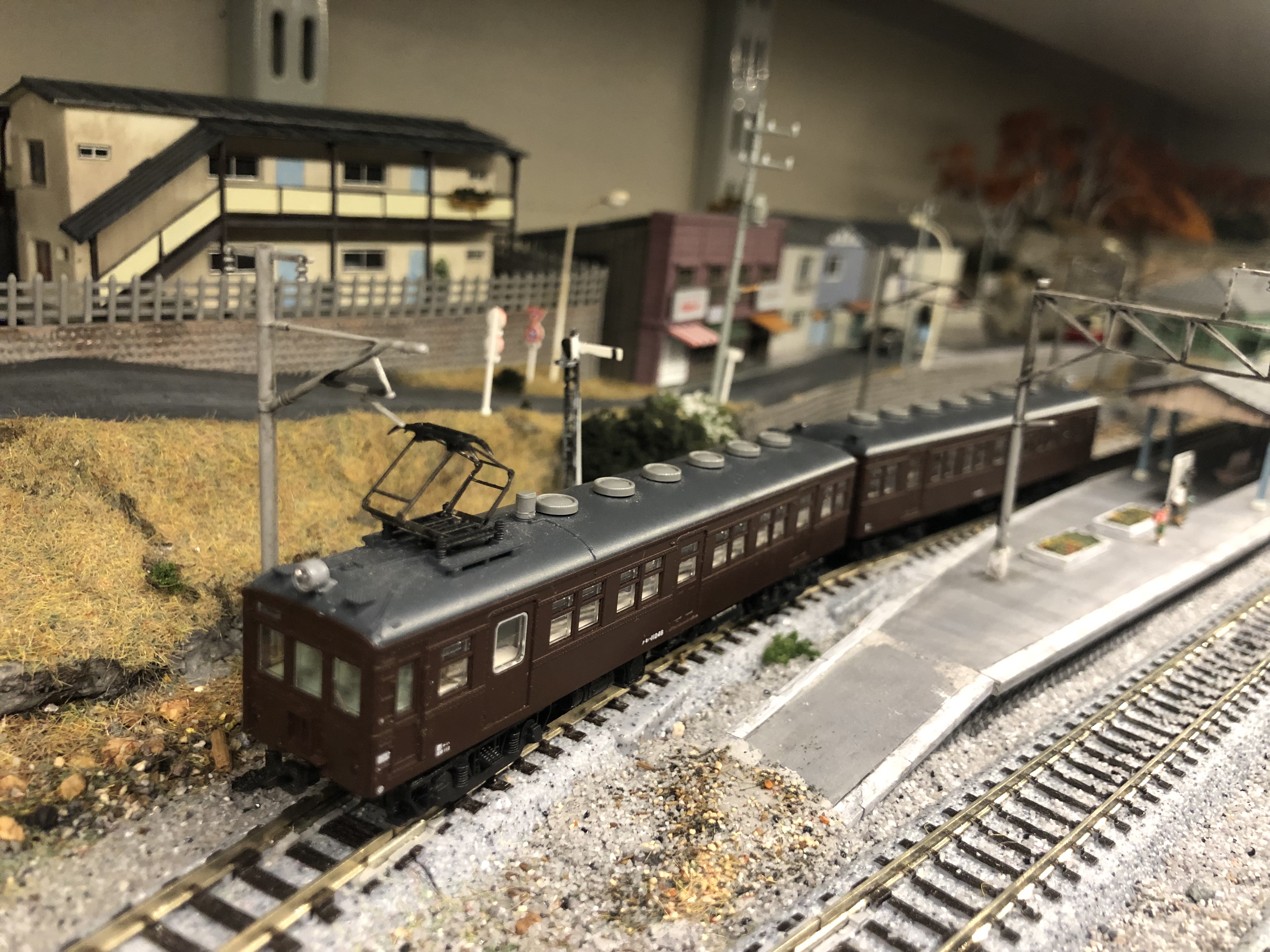
    This model was bought with a specific project in mind. Not having the space for anything serious, I thought about creating a Japanese-style layout on a circular piece of wood I'd come across in a charity shop. What I needed was a quaint railcar or EMU to run on it, something happy to go around a circle of track just 30 cm in diameter. Although not the most colourful train that Kato produce, this unit does the job and has some nice details and an old-fashioned look that make it a charming addition to the fleet.

    Background

    Built at various points during the late 1920s, these sets were ordered by the Ministry of Railways to replace older wooden-bodied units (the DeHa 63100 series). Although those units had worked well, building wooden bodies had become expensive after an earthquake increased demand for timber, and on top of that, wooden bodied cars didn't provide much protection for passengers during collisions.

    The new railcars used standardised underframes and bogies. Steel plates were attached to the frame of the body using rivets, while additional strips of steel reinforced the plating around the windows. Additional ventilation was added to the roof, while curtains were added to the windows instead of shutters.

    Maximum speed was 95 km/h. Seating was third-class throughout.

    Kato 10-1345 KuMoHa 11 200-series


      What's in the box?

      • One powered car with pantograph and one unpowered trailer car
      • Working headlights and taillights
      • Sprue with assorted plastic parts such as cables and ATS gear
      • Sticker sheet including train numbers and destination headcodes suitable for the Nambu branch and main lines, the Tsurumi line and the Ome line
      On the one hand, the colour scheme isn't the most exciting. The seating inside the cars is plain off-white plastic looks very plain. As per the prototype, the seating runs longitudinally along the car, and other than these 'benches' there's really not much to see inside the cars. On the real things, the upholstery is blue, so painting them is certainly one possible upgrade. Adding some seated passengers, and a driver in the cab, would also make a big difference.

      But on the other hand, the models themselves are cleverly designed and include some excellent features. Starting with the underframe detailing, there's a lot to see here, including all sorts of pipes and rods. The wheels are spoked and look very nice indeed.

      The couplings are used are not Rapido couplings but adaptations of the classic Japanese Shibata coupler. These work well, but you can't easily join them together on very tight curves (such as 15 cm radius Unitrack). I ended up replacing them with home-made neodymium magnet couplers that do the job nicely on circular layouts. That aside, what's really impressive about the couplers is the 'kinematic' hinge they're attached to on the body, rather than the bogies. This clever device allows the couplings to swing freely, while being gently centring, keeping the cars quite close together even on tight bends.

      Inside the power car there's a motor with two flywheels, connected via cardan shafts to both bogies. Electrical pick-up is via the pin-point bearings on all eight wheels of the power car. There are no traction tyres, but haulage is more than adequate for the two cars in the unit and a couple more unpowered cars if you wanted to add them (Kato #10-1347, Tsurumi Line 2-Car Extension Set).


      On both cars, the body unclips to reveal a couple of extra goodies. One is a small switch for turning on and off the headlights and taillights. This is useful when coupling together two sets to make a four-car train: the lights on the inward-facing cabs would not normally be in use, so shouldn't really light up when the train is running.

      The other useful fixture are the standard Kato lighting kit attachment slots. As always with installing these kits, the instructions are somewhat generalised so a certain amount of fettling may be required, but once installed, the results are worthwhile.

      Conclusion


        As the video above hopefully shows, this is a decent model that works astonishingly well even on ridiculously tight curves. The motor isn't quite as silent as some of the more recent ones used by Kato, but the noise it makes isn't obtrusive by any means.

         While the styling and livery might best be described as workmanlike, as an 'old time' model this is a useful little train for suburban branchlines set anywhere between the 1920s and 1970s.

        Sunday, 22 September 2024

        Review: Kato Roundhouse 10-913 485-Series 'Kirishima - Hyuga Type'

        Bit of a labour of love this one. While picked up inexpensively as a secondhand model, the sellers description that it 'ran' was only true in the loosest sense of the word. With only a single bogie working, and even that one growling and offering insufficient traction, the train just about crawled along, and needed occasional nudges to keep going. But after a few false starts, the model was fixed and now runs quite well.

        Background

        For me, this is an example of one of the most characteristic Japanese electric trains. Built between 1964 and 1979 across several different series, the type lasted in regular service until 2017. A few soldiered on on special services until 2022. They were intended to work on both AC and DC routes at up to 120 km/h, though the type could apparently reach speeds of up to 160 km/h safely.

        The design was based on the earlier 151-series, and the earlier 485-series trains had similar front ends including the long, streamlined nose. From 1972 onwards, they were instead built with more flattened front ends that made it easier to couple two units together to form a single train. One distinctive feature of the type is the illuminated headboard panel at the nose, which in typical Japanese style has both the name of the train and some sort of colourful artistic flourish.

        Inside, the trains were equipped to provide a comfortable environment in both hot and cold weather. The standard train comprised 11 cars including two first class cars and a dining car.

        This particular model, however, is of a three-car variant as it operated between 2000 and 2011 on as the Kirishima & Hyuga limited express between Miyazaki and Kagoshima in the Miyazaki Prefecture on the southern tip of Kyushu.

        Kato 10-913 485-Series 'Kirishima - Hyuga Type'


           What's in the box?

          • Two Kuha cab cars with working headlights, taillights, and illuminated headcode
          • One powered Moha car with pantograph
          The model didn't come with any extra parts. The instructions are printed on the back of the box. One cool feature though is that the illuminated headboard can be rotated using a very small flat-head screwdriver inserted into a small hole under the nose. The model can also be upgraded for internal lighting using the Kato 11-201 kits. 

          Although the model is equipped with headlights, taillights, and the backlit headboard, these are barely visible until the train is running at close to full speed. That's a bit disappointing since they add a lot of character to this sort of train.

          Getting the thing running properly again!

            As it came, the model barely ran and one of the couplings was broken.

            Replacing the broken coupling, at least, was easy. A set of Kato 11-705 Type B Black Couplers was bought from TrainTrax and arrived within a couple of days. The broken one was pulled out, and after assembly, a new one pushed into the receptacle. So far, so good!


            Getting the model running properly was more of a problem. One problem was a missing cardan shaft between the motor and one of the bogies. The motorised unit drives both bogies, and each bogie is connected to the motor via a green cardan shaft that has a similar sort of fitting at each end. The bogies pop out easily if pulled and twisted slightly, and presumably at some point in its life, the owner of this model had done that and lost one of the cardan shafts.


            So, after rooting about the Kato website, I managed to find the cardan shafts used on the current 485-series models. I ordered a pack, and again, TrainTrax delivered them in a couple of days. But alas, they were not the right sort, as you can see in the picture above.

            After a couple of emails to Kato, one of their engineers offered a solution! This particular model has been out of production for a while, and spare parts aren't available. But a different sort of bogie, ASSY #41912ZD1, would fit the model and had the right sort of cardan shaft. The engineer was absolutely right, and after receiving these from Kato, I popped them into the train and put it on the tracks. Off it went!

            The story isn't over yet, though. While the motorised car now ran beautifully, the replacement bogies were designed for a different sort of train. The couplings were set back so far that it couldn't connect up to the two unpowered cars. Or rather, they'd connect on a straight, but as soon as the train hit a curve, it would derail.

            With the couplings pulled out from their clip fitting, and then pushed in only a little bit, they could be glued to about the right length. Superglue did the job, and once dried, the bogies were put back into the train and tested. All went well! 

            While the bogies aren't the same colour as the originals, that can be easily fixed with some black paint. The main thing is that the model runs and brings a delightful splash of colour to the layout.

            Conclusion


              Operation is pretty good. Overall, the model runs smoothly, if not quite as quietly as the latest Kato trains. The motorised car seems to have no problems hauling the two unpowered cars. As mentioned above, the lighting is lacklustre, but otherwise this is an attractive train well worth the effort it took to get up and running.


              Sunday, 1 September 2024

              Review: Kato 10-034 passenger car set

              There's a review of the freight car starter pack elsewhere on this blog. It's the passenger car pack that's being looked at now, one of two in fact. One contains four coaches in the old (post-war) brown livery of JNR, while the other contains four coaches in the JNR blue livery introduced in 1964 and consequently more typical of trains after the steam era. While the contents of the two packs appear similar (apart from the colours, of course) they do not include exactly the same four types of coach.

              Background

              Nowadays, multiple unit trains, particularly electric multiple units, carry most of the passengers on Japanese railways. But in the past, coaches (or passenger cars) of various kinds were common. The ones included in this Kato pack represent postwar (JNR) designs that would be hauled by locomotives such as the D51 for long distances or C11 and C12 tank engines on branch lines. They were built between 1951 and 1955, though modernised and modified in later years, for example by having air conditioning installed and the wooden-framed windows replaced with ones with aluminium frames.

              Most of these old coaches were phased out of use during the early 1980s, but a few remain in service even today for special trains such as excursions behind steam locomotives. This makes this sort of pack useful even for modellers setting their layouts in the present day. There was also a long period of time during the 1960s and 70s where the original brown coaches and the refurbished blue coaches might be marshalled into the same train. So, again, while this pack is ideal for the steam-era modeller, it will also have use on layouts featuring diesel and electric locomotives.

              The basic design of these coaches will be familiar to modellers from all around the world: steel frames with wooden bodies, two-axle bogies, corridor connections, and air vents (rather than air conditioning) on the roof to provide ventilation in summer. Although built to mainline standards, and frequently used on named express trains, these coaches were not designed to run at speeds above 95 km/h.

              Kato Freight Car Park (10-033)

              What's in the box?
              • Suyuni 60 baggage/mail car with working taillights
              • Oha 46 third class open car
              • Suha 43 third class open car
              • Ohafu 45 third class (brake) with working taillights
              • Tool for moving the light switches on and off

              The four coaches are pretty similar in specification, with Rapido couplings, all-wheel axle-point electrical pick-up, chemically-blackened disk wheels, and removable roofs that allow for quick installation of the Kato lighting kit.

              At first glance they all look pretty similar, but the shade of grey used for the roof varies between the light grey of the Ohafu 45 and the dark grey used on the other three cars. The livery is simple but nicely applied, with a satin finish and very neat lettering. The inside details are all moulded in the the one colour.

              There are essentially no fitted details beyond the corridor connection frames. Handrails, footsteps, lamps, etc., are all moulded onto the body. While this works well enough, it doesn't quite match the standards seen on the state of the art passenger cars (like the Farish-Bachmann 'blue riband' series in the UK).

              Two of the cars come with red taillights at one end. These can be switched on or off using a sliding switch underneath. Turning the coaches over also reveals the underframe detailing that includes brake piping, water tanks, etc. You can also see how the Rapido couplings are fitted onto the bogies with the usual copper spring behind them to keep them centred. These can be upgraded to knuckle couplers (Kato #11-702) or magnetic couplers (Kato #11-711) if preferred, but these alternate couplings are not included in the set.


              Conclusion

              As with the freight car pack, there's a lot of value in this set. The RRP in Japan is 8,250 Yen (about £43 at the time of writing) which compares very favourably with the RRP of coaching stock in the UK. Basically, for what you're getting here, you'd be lucky to get one, maybe two British outline coaches. But with that said, the specification here is a bit mixed. Interior lighting is always nice, but the lack of separately fitted detailing results in a rather 'flat' appearance when examined closely.

              So, while you are getting a good set of coaches, serious modellers might want to make a few upgrades to bring things up to modern standards. One other obvious upgrade worth doing is the replacement of the disc wheels with more authentic spoked wheels. Presumably, these were not included as standard to keep costs down. Similarly, if you install the lighting kit, the lack of passengers will become more obvious, so you might want to do is add some passenger figures. Needless to say, Kato do their own, but since figures inside models aren't easily seen, you could just as easily use the economical (if garishly painted) figures sold in eBay and the like.

              Overall though, this is a good way to get some passenger trains up and running on your layout, whether you're modelling the steam era or early diesels and electrics.

              Kato Mini Diorama

              Built this for the Warners model railway exhibition at the Birmingham NEC last year. Can you guess what it is? The model, by the way, is the...